
What Is Zinc-Nickel Alloy Plating? A Complete Guide
Key Takeaways
- Zinc-Nickel plating deposits a zinc alloy containing roughly 12-15% nickel, far outperforming standard zinc coatings - With trivalent chromium passivation it withstands 720+ hours of salt spray without red rust — up to 2,000 hours in high-spec processes - It is the go-to finish specified by global automakers for engine-bay and chassis fasteners
How Zinc-Nickel Plating Works
Zinc-Nickel plating co-deposits zinc and nickel into a gamma-phase alloy layer containing roughly 12-15% nickel. The nickel content shifts the coating potential closer to the steel substrate, slowing sacrificial consumption — so at equal thickness the coating lasts several times longer than standard zinc.
A trivalent chromium passivate and sealer applied afterwards further improve white- and red-rust resistance while complying with EU ELV and RoHS restrictions on hexavalent chromium.
Corrosion Resistance vs. Standard Zinc
In neutral salt spray (NSS) terms, trivalent zinc coatings are typically specified at 72-240 hours to red rust; Zinc-Nickel routinely reaches 720+ hours, and well-passivated, sealed high-spec processes achieve 2,000 hours without red rust.
- Heat resistance: the coating keeps protecting above 120°C, suiting engine-bay parts
- Lower galvanic corrosion when in contact with aluminum components
- A harder deposit that resists assembly-line scratching
Automotive Applications and OEM Standards
Zinc-Nickel is the finish of choice in OEM specifications for fasteners in corrosive locations — common standards include GMW4700, VW 13750 / TL 244, PSA B15 4102, DIN 50979, and ASTM F1941M. Engine bolts, chassis fasteners, and brake components typically call for Zinc-Nickel with trivalent passivation.
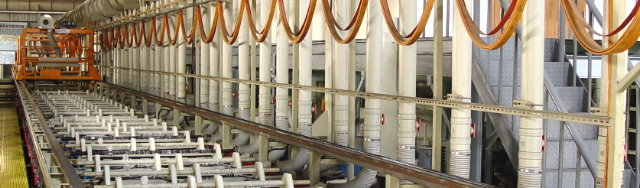
MAPT runs trivalent Zinc-Nickel lines with one rectifier per barrel and a closed-loop passivation recycling system, certified to IATF 16949 for volume production against these standards.
FAQ
- When fasteners serve engine bays, chassis, or brake systems, or when customers specify OEM standards such as GMW, VW, or PSA, the corrosion life and compliance of Zinc-Nickel cannot be matched by standard zinc.
- Yes. Black trivalent passivation produces a uniform black appearance while keeping corrosion performance, and is common for visible and interior fasteners.
- With proper passivation and sealing, production-grade Zinc-Nickel plating typically reaches 96-480 hours to white rust and 720-2,000 hours to red rust. Actual results depend on coating thickness, passivation system and sealer, so confirm the test basis in your specification first.